Xfinity Assistant:
Architecture & Strategy
Architecting an AI assistant at scale
Architecting an AI assistant at scale
How I shaped Xfinity Assistant's evolution across strategy, decisions, experience, and team enablement, from an executive vision to the tools my team uses every day.
Role: Senior UX Strategist
Scope: Future Experience Strategy - Conversational AI platforms
Audience: Product, engineering, business partners, and the Chief Growth Officer's leadership team
The Moment
Xfinity Assistant is one of the first places millions of Xfinity customers go when they have a question about their bill, their service, or their account.
At that scale, every design choice carries real weight: a small improvement in how the assistant resolves a question means fewer calls to care agents, lower operating cost, and customers who trust the brand a little more.
As agentic AI moved from buzzword to boardroom priority, the questions got bigger.
What should the assistant be able to do on its own?
How do we build it without costly rework?
How should it treat people in stressful moments?
How does a design team keep up with the pace of change?
I worked on all four questions at once.
Together they became one connected body of work.
Four layers,
one system
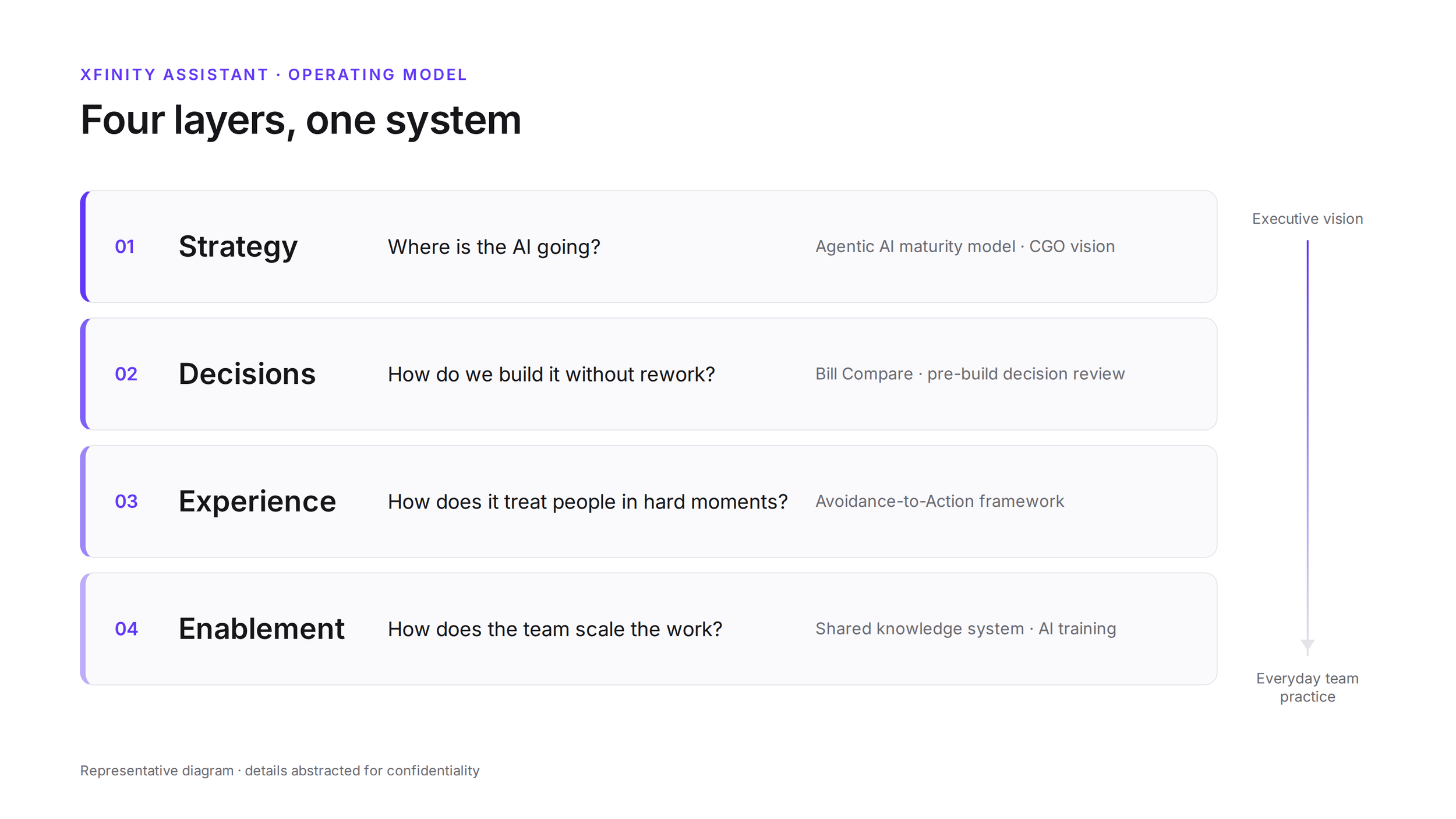
Each project I led answered a different layer of the same problem.
Seen together, they form an operating model for building AI experiences responsibly at enterprise scale: a clear direction at the top, disciplined decisions before anything is built, experiences designed around how people actually feel, and a team equipped to carry the work forward.
01 · Strategy
Defining what the assistant should do, and when
Leadership needed a shared picture of what agentic AI would mean for our customers. Without one, every team was forming its own interpretation, which risks duplicated effort, competing priorities, and investment spread too thin to matter.
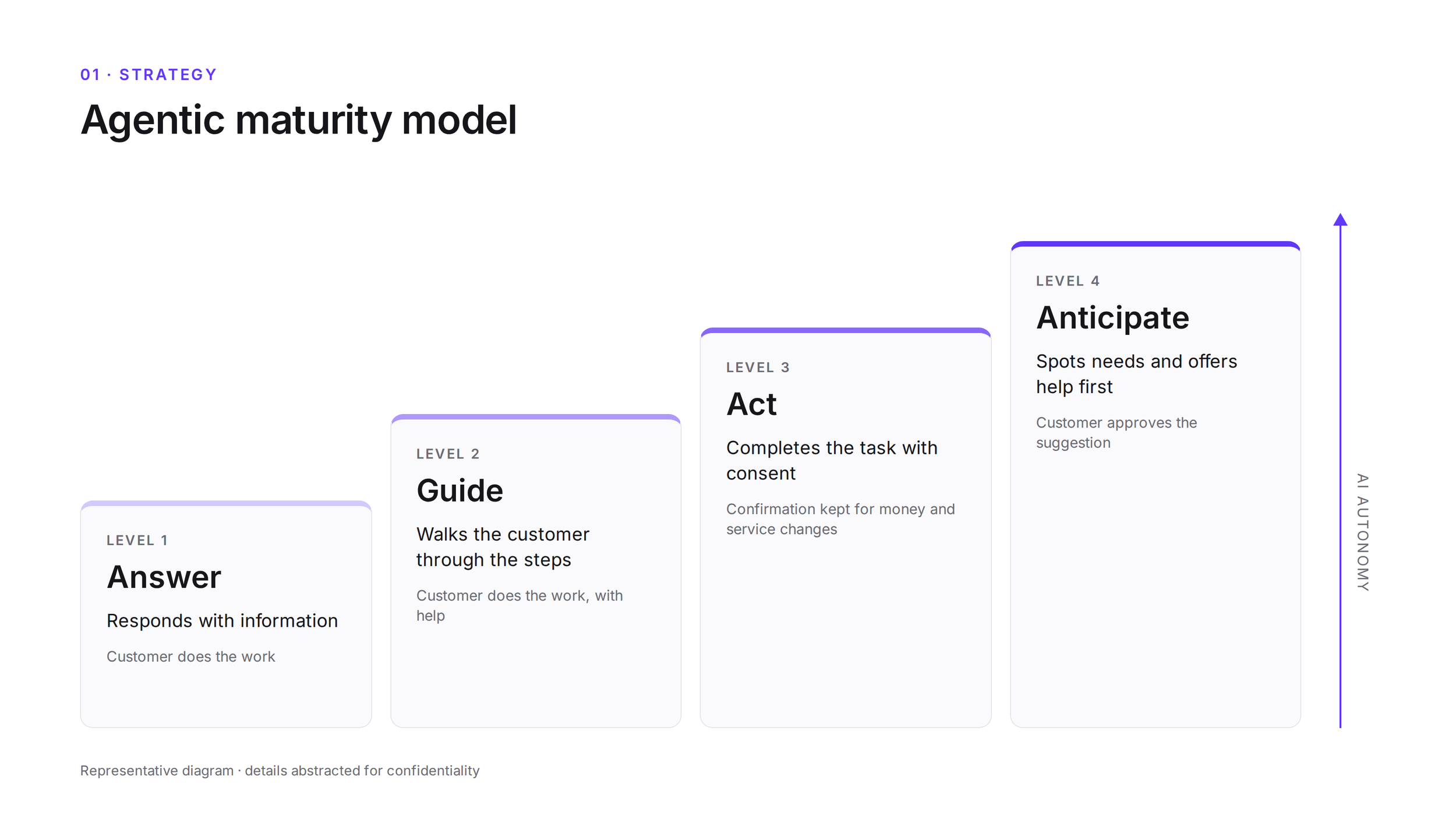
I built a maturity model that moves each customer journey through four levels: Answer, Guide, Act, and Anticipate. Every journey gets mapped to where it sits today and where it should go next, which turns an abstract ambition into a sequenced plan.
The key decision: autonomy scales with risk. Low-stakes tasks move to "Act" first. Anything involving money or service changes keeps a confirmation step, so the assistant earns trust before taking on more.
Value created:
Alignment: leaders gained a shared language for agentic AI, so conversations moved from "should we do this?" to "which journey is next, and what will it take?"
Smarter investment: a clear sequence means budget and engineering capacity go to the journeys most ready to deliver value, instead of being spread across experiments.
Protected trust: tying autonomy to risk guards against the most expensive failure an AI can have, which is acting wrongly on a customer's money or service.
Outcome: Presented to the Chief Growth Officer's leadership team and recognized with a Stellar Award.
02 · Decisions
Resolving the hard questions before the build
Bill Compare explains to customers why their bill changed, one of the most common reasons people reach out for help. The team was ready for engineering, but foundational questions were still open. Left alone, they would have surfaced mid-sprint as rework.
That matters because engineering is the most expensive stage of building anything. A change made during design costs hours. The same change made in code costs sprints, and in production it costs customer trust and extra support calls on top of that. Getting the answers right before development starts is one of the highest-return moves a product team can make.
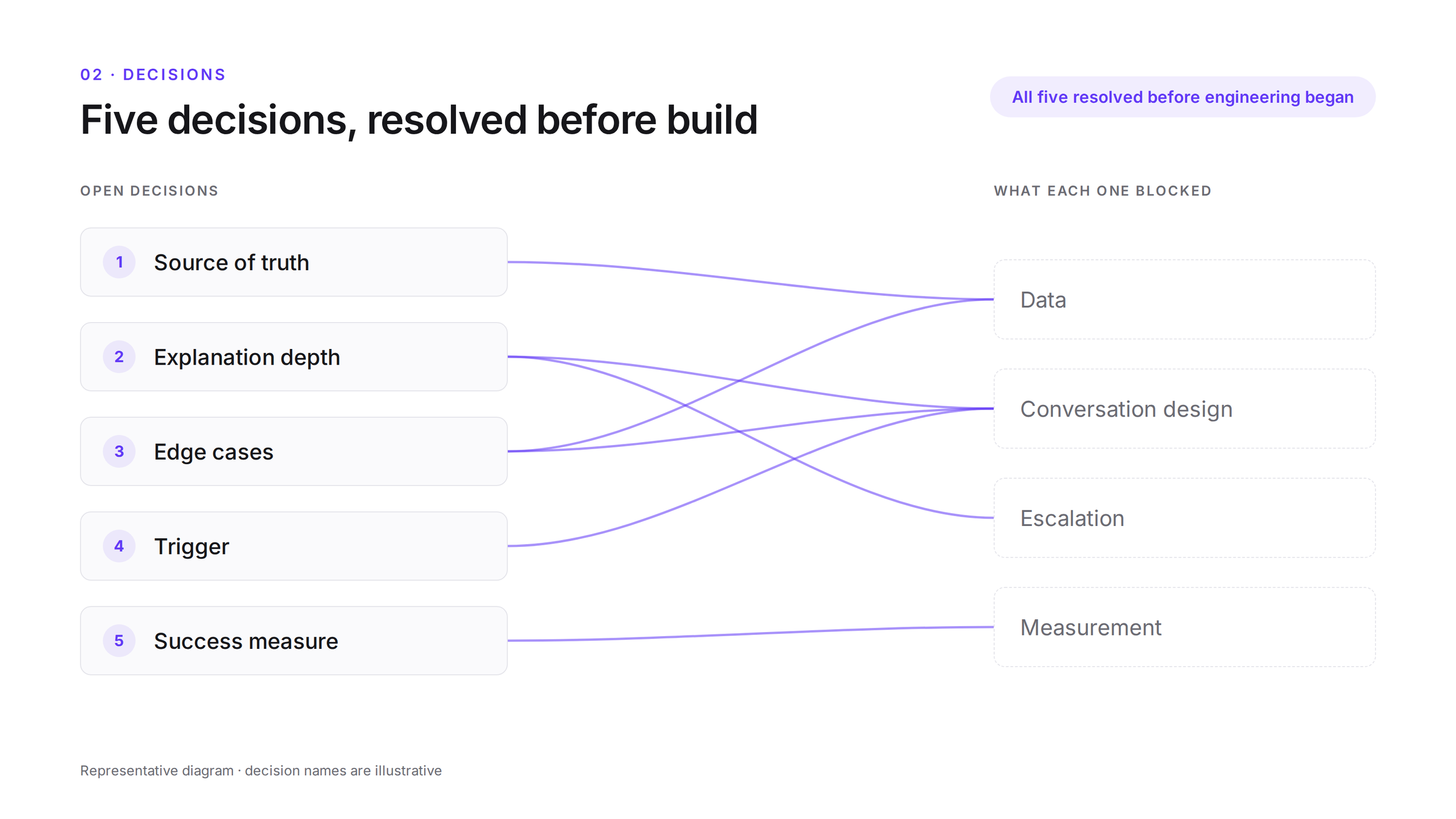
I mapped the full experience, pulled out five build-blocking decisions, and brought each one to its owner with the trade-offs laid out. They covered areas such as which system is the source of truth when billing data disagrees, how much detail to explain before offering a human, and how to handle edge cases like prorations and expiring promotions.
Value created:
Cost avoided: engineers built once, against settled requirements, instead of rebuilding when late answers changed the plan.
Time protected: the delivery timeline held because blockers were cleared before they could stall a sprint.
Accuracy where it counts: when the topic is someone's bill, a wrong or confusing answer drives a call to an agent. Settling the logic upfront means customers get explanations they can trust, and fewer of them need to call.
A repeatable practice: the pre-build decision review became a pattern the team can apply to future assistant features.
Outcome: All five decisions were resolved before engineering began.
03 · Experience
Designing for people who don't want to talk about money
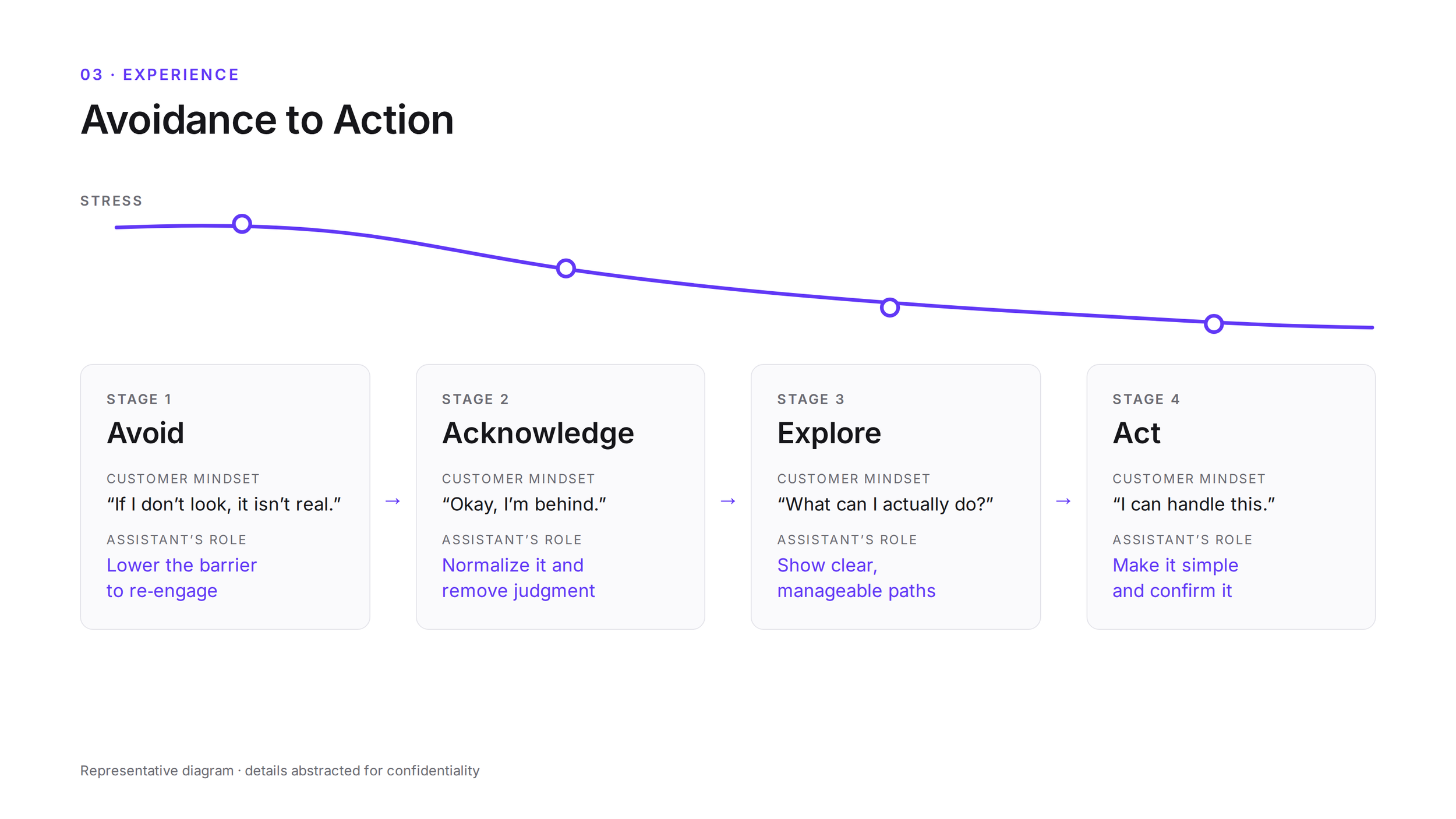
Customers who fall behind on payments often avoid the problem until service is at risk. Traditional collections messaging makes that worse: pressure and large balances trigger more avoidance, and by the time the customer engages, the options are narrower and the relationship is strained.
I created the Avoidance-to-Action framework, which meets customers where they are emotionally and moves them through four stages: Avoid, Acknowledge, Explore, and Act.
The key decision: lead with a manageable next step. Showing the full balance first triggers avoidance, while a clear, small action invites engagement.
Value created:
Earlier engagement: reaching customers before service is at risk keeps more of them on a path to resolution, protecting revenue that would otherwise be lost.
Lower cost to resolve: customers who can take the next step in the assistant need fewer agent-handled collections conversations.
Relationships preserved: a customer who catches up without feeling judged is far more likely to stay. Retention is worth more than any single payment.
Outcome: The framework gave the team a shared model for designing collections journeys in Xfinity Assistant around customer behavior and emotion.
04 · Enablement
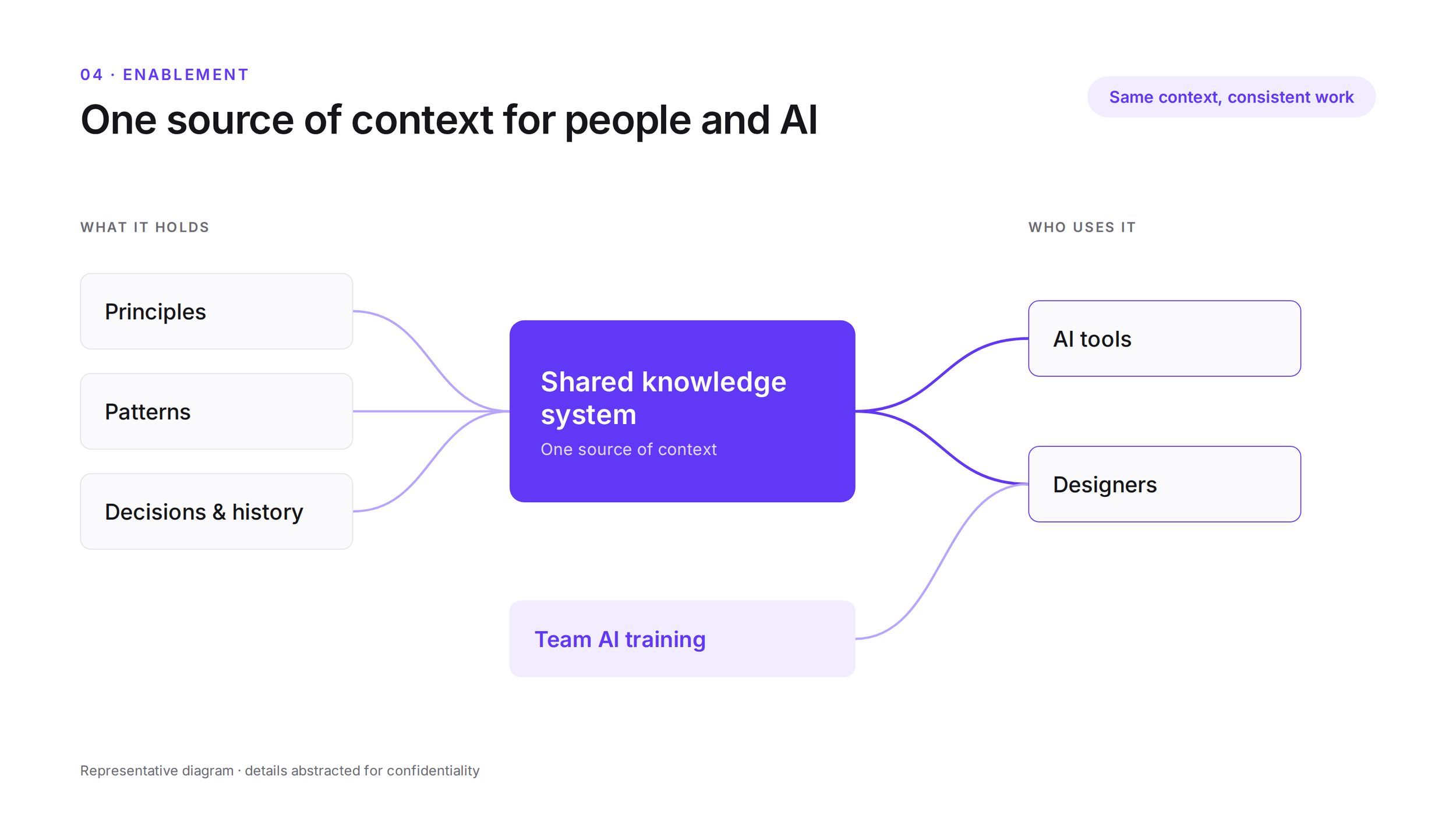
Strategy only matters if a team can carry it forward. As AI tools entered everyday design work, the risk was that each person would use them differently, with inconsistent results and knowledge locked in individual heads.
I built a shared knowledge system that gives designers and AI tools the same context about Xfinity Assistant (its principles, patterns, and history), so new work starts from what we already know. I also created team training on working with AI tools, covering mental models and practical frameworks for everyday design work, along with shared guidance on writing with AI.
Helping the team scale the work
Value created:
Faster ramp-up: new team members and partners can get oriented from one source instead of piecing context together over weeks.
Consistency at speed: when people and AI tools draw from the same principles, output stays on-strategy even as the team moves faster.
Knowledge that lasts: decisions and rationale are captured in one place, so they survive reorganizations and team changes.
Outcome: The team gained a common foundation for using AI in its work, turning individual experimentation into a shared practice.
What connects the work
→
Autonomy scales with risk
The more a decision affects someone's money or service, the more control stays with the customer.
→
Decide before you build
Answers are cheapest in design and most expensive in code. Surfacing hard questions early protects both budget and timeline.
→
Design for how people feel
Behavior follows emotion, especially in high-stakes moments like billing and payments.

Where I'd take it from here
The next frontier is measurement: defining the signals that show when a journey is ready to move up a level of autonomy, such as completion rates, reversal rates, and customer confidence.
Get that right, and the maturity model becomes a live system for deciding where AI should act next, and where the next dollar of investment will return the most.
NOTE: Details, names, and data have been changed or abstracted to protect confidentiality. Full walkthroughs are available in conversation.